
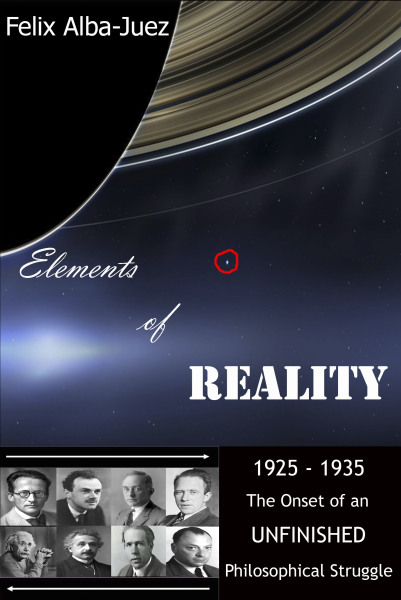
Quantum Physics free of Folklore · Book 4
Elements of REALITY
1925–1935: The Onset of an Unfinished Philosophical Struggle
The formative decade of quantum theory and the still-unfinished dispute over what the theory says is real.
Find this title on AmazonOverview
About the book
Elements of REALITY follows the philosophical struggle that emerged with quantum theory between 1925 and 1935. It examines competing interpretations, nonlocality, the EPR argument, quantum information, and the persistent question of what qualifies as an element of physical reality.
Inside the book
The argument, in full.
The Cassini spacecraft once recorded Saturn’s rings and Earth—the pale blue dot—in one frame. Felix treats that remote physical record as a doorway into the unfinished dispute over observers, information, measurement, nonlocality, and what deserves to be called real.
- 01
How probability amplitude and phase can be approached through sunglasses, television, intensity, and interference.
- 02
Why a physical property may be the probability distribution of its possible values.
- 03
How spin, the Zeeman effect, and the Stern–Gerlach experiment clarify measurement.
- 04
Why the uncertainty relation is a theorem rather than a measurement principle.
- 05
How entanglement, quantum computing, and quantum cryptography depend upon nonlocal structure.
- 06
Why the EPR argument remains central to the dispute about physical reality.
Edition represented
2019
- Author
- Felix Alba-Juez
- Language
- English
- ISBN-13
- 9781698060613
- Series
- Quantum Physics free of Folklore · Book 4
Recognition
Featured by BookAuthority.
“Absolutely brilliant and highly recommended. A rare example of a serious, highly informative popular-science publication that delivers precise and mathematically accurate content within an attractive, scientifically grounded, lucid philosophical standpoint.”
“Another historical and scientific gem in the series, with clear and informative examples and critique. The intangible concepts of quantum mechanics are firmly restated in real terms with intuitive examples and mathematical clarity while maintaining the deeper philosophical fabric.”